
Showing posts with label Astronomy. Show all posts
Showing posts with label Astronomy. Show all posts

September 12, 2013
Leaving Earth
What it would look like to leave planet Earth? It's an easy and scary thing to imagine as you watch this video. Such an event was recorded visually in great detail by the MESSENGER spacecraft as it swung back past the Earth, eight years ago, on its way in toward the planet Mercury. Earth can be seen rotating in this time-lapse video, as it recedes into the distance. The sunlit half of Earth is so bright that background stars are not visible. The robotic MESSENGER spacecraft is now in orbit around Mercury and has recently concluded the first complete map of the surface. On occasion, MESSENGER has continued to peer back at its home world. MESSENGER is one of the few things created on the Earth that has left and will never return -- at the end of its mission MESSENGER will be crashed into Mercury's surface.
July 01, 2013
Cosmos: A Personal Journey - by Carl Sagan
With Cosmos, Carl Sagan and his wife and co-writer, Ann Druyan, brilliantly illustrated the underlying science of his same-titled book, placing the human species within a space-and-time context that brought the infinite into stunningly clear view. The series, which originally aired in 1980 on PBS, has been seen by more than 700 million people worldwide and remains a high-water mark in the history of television miniseries.
Sagan lucidly explains such topics as Einstein’s theory of relativity, Darwin’s theory of evolution, and the greenhouse effect, bringing the mysteries of the universe down to a layman’s level of understanding. The footage in these remastered, seven-DVD or seven-VHS sets is as fresh and riveting as it was two decades ago and is certain to fire the imaginations of a whole new generation of viewers.
May 13, 2013
May 08, 2013
The Overview Effect
Some Strange Things Are Happening To Astronauts Returning To Earth.
Who would have thought traveling to outer space could be such a profound experience? OK, probably everybody, but these former astronauts really articulate it in a way that was just a little mind-blowing.
Who would have thought traveling to outer space could be such a profound experience? OK, probably everybody, but these former astronauts really articulate it in a way that was just a little mind-blowing.
August 02, 2012
June 09, 2012
May 31, 2012
The Light of Stars
Time lapse videos of the sky can be quite spectacular when they last long enough for stars, planets, aurora, and clouds to appear to move in just a few seconds. Pictured above, however, astrovideographer Daniel López not only treats us to several inspiring time lapse videos of the night sky, but shows us how he used sliders and motorized cranes to move the imaging cameras themselves, creating a thrilling three-dimensional sense of depth.
The video sequences were taken from Tenerife on the Canary Islands of Spain over the past two months, and show scenes including sunset shadows approaching Observatorio del Teide, the Milky Way shifting as the sky rotates, bright planets Venus and trailing Jupiter setting, a reddened Moon rising through differing layers of atmospheric refraction, the MAGIC gamma-ray telescopes slewing to observe a new source, and unusual foreground objects including conic Echium wildpretii plants, unusual rock formations, and a spider moving about its web. The video concludes by showing the Belt of Venus descending on Mt. Teide as the morning sun rises.
Video Credit & Copyright: Daniel López (El Cielo de Canarias); Music: La Busqueda de Ianna
May 25, 2012
Cartoon explains the Higgs boson
What is all this fuss about the Higgs boson? The physics community is abuzz that a fundamental particle expected by the largely successful Standard Model of particle physics may soon be found by the huge Large Hadron Collider (LHC) at CERN in Europe. The term 'boson' refers to a type of fundamental particle with similarities to the photon, while Higgs refers to Peter Higgs, a physicist who among others published research predicting the mechanism through which such a particle might act. The above animated cartoon explains in humorous but impressive detail why the Higgs boson is expected, and one method that the Large Hadron Collider is using to find it. Although some rumors hint that preliminary traces of the Higgs boson are already being found, even not finding this unusual particle would open the door to a new fundamental understanding of how our universe works.
May 02, 2012
Hubble Captures Incredible New Panorama of Tarantula Nebula

Millions of young stars shine brightly in this enormous stellar nursery at the heart of the Tarantula Nebula.
The Hubble space telescope captured this amazing panorama, which reveals intricate details about the expanse known as 30 Doradus. Located about 170,000 light-years away in the Large Magellanic Cloud — a small galaxy orbiting our Milky Way — 30 Doradus is one of the largest and most prolific star-forming regions in our galactic neck of the woods.
The region is so huge that, if it were as close to us as the Orion Nebula (the nearest stellar nursery to Earth, about 1,300 light-years away), it would be the size of 60 full moons in the sky and glow so brightly that it could cast shadows on the ground.
Though 30 Doradus isn’t quite that close, Hubble can still resolve the individual stars inside the region, allowing astronomers to study the lives of stars in detail.
Stars are born when a mass of gas and dust collapses under its own weight. The center of this mass gravitationally attracts more material, growing larger and heavier. The extra material increases the density and temperature in the central region. Eventually, the mass reaches a critical point and hydrogen will begin fusing into helium. The star ignites, releasing copious amounts of heat and energy.
Inside 30 Doradus, Hubble can spot stellar babies, only a few thousand years old and still wrapped in the remnants of the dusky cloud of gas that gave rise to them. It can also see massive stars a few tens of millions of years old, which burn through their fuel fast and die young.
The white region in the left side of the picture contains some of the most massive stars in the universe, weighing in at hundreds of times the sun’s mass. This stellar cluster is roughly 2 million to 3 million years old and contains about 500,000 stars in total. Intense ultraviolet light released by the young stars pushes against the surrounding gas and dust, carving out the beautiful structures and filigrees seen in this image. Some of this gas and dust will be mushed together, increasing its density and potentially sparking the birth of more new stars.
The new image was released Apr. 17 in honor of Hubble’s 22nd year in orbit. You can download the image at 4,000 x 3,200 pixels, but if you want to really zoom in on the picture, download the insanely large version of 20,323 x 16,259-pixels. (Warning: It’s 643 MB.)
Via wired science
April 11, 2012
Io: Moon Over Jupiter
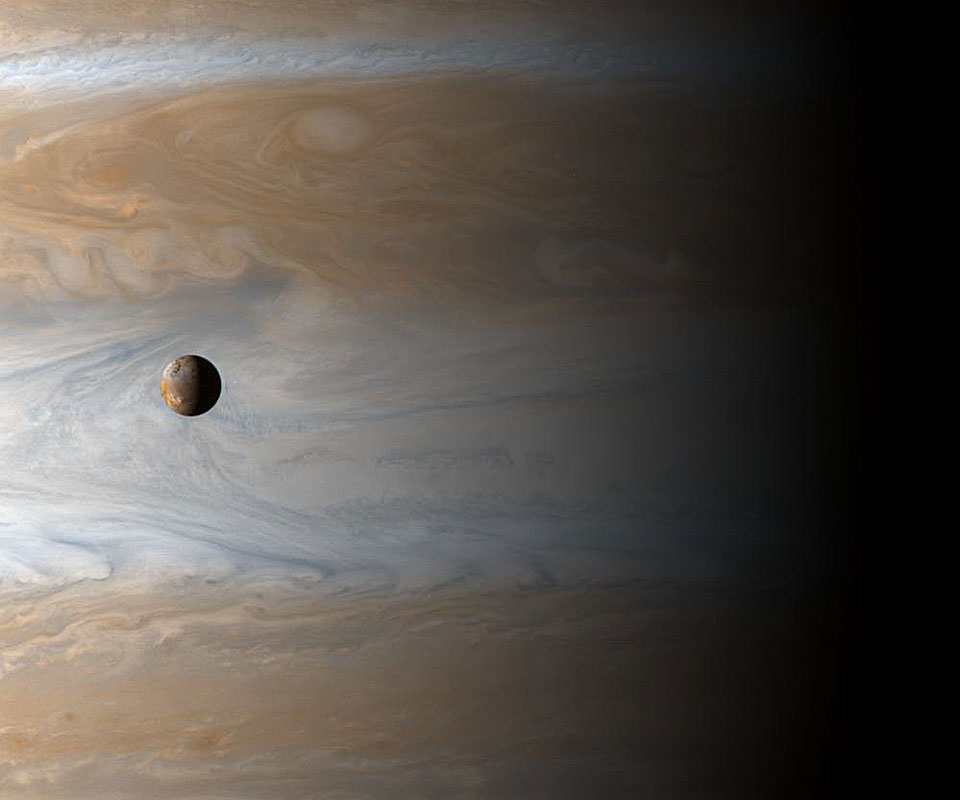
How big is Jupiter's moon Io? The most volcanic body in the Solar System, Io (usually pronounced "EYE-oh") is 3,600 kilometers in diameter, about the size of planet Earth's single large natural satellite. Gliding past Jupiter at the turn of the millennium, the Cassini spacecraft captured this awe inspiring view of active Io with the largest gas giant as a backdrop, offering a stunning demonstration of the ruling planet's relative size. Although in the above picture Io appears to be located just in front of the swirling Jovian clouds, Io hurtles around its orbit once every 42 hours at a distance of 420,000 kilometers or so from the center of Jupiter. That puts Io nearly 350,000 kilometers above Jupiter's cloud tops, roughly equivalent to the distance between Earth and Moon. The Cassini spacecraft itself was about 10 million kilometers from Jupiter when recording the image data.
March 12, 2012
The Scale of the Universe - Interactive
What does the universe look like on small scales? On large scales? Humanity is discovering that the universe is a very different place on every proportion that has been explored. For example, so far as we know, every tiny proton is exactly the same, but every huge galaxy is different. On more familiar scales, a small glass table top to a human is a vast plane of strange smoothness to a dust mite -- possibly speckled with cell boulders. Not all scale lengths are well explored -- what happens to the smallest mist droplets you sneeze, for example, is a topic of active research -- and possibly useful to know to help stop the spread of disease. The above interactive flash animation, a modern version of the classic video Powers of Ten, is a new window to many of the known scales of our universe. By moving the scroll bar across the bottom, you can explore a diversity of sizes, while clicking on different items will bring up descriptive information.

Flash Animation Credit & Copyright: Cary & Michael Huang
March 09, 2012
Flying Over the Earth at Night
Many wonders are visible when flying over the Earth at night. A compilation of such visual spectacles was captured recently from the International Space Station (ISS) and set to rousing music. Passing below are white clouds, orange city lights, lightning flashes in thunderstorms, and dark blue seas. On the horizon is the golden haze of Earth's thin atmosphere, frequently decorated by dancing auroras as the video progresses. The green parts of auroras typically remain below the space station, but the station flies right through the red and purple auroral peaks. Solar panels of the ISS are seen around the frame edges. The ominous wave of approaching brightness at the end of each sequence is just the dawn of the sunlit half of Earth, a dawn that occurs every 90 minutes.
Video Credit: Gateway to Astronaut Photography, NASA ; Compilation: Bitmeizer (YouTube);
Music: Freedom Fighters (Two Steps from Hell)
February 23, 2012
Aurora
Video Credit & Copyright: Christian Mülhauser; Music: Elemental by Pulse Faction; Path of Stars by Jonathan Geer.
Auroras are occurring again with increasing frequency. With the Sun being unusually dormant over the past four years, the amount of Sun-induced auroras has been unusually low. More recently, however, our Sun has become increasingly active and exhibiting a greater abundance of sunspots, flares, and coronal mass ejections. Solar activity like this typically expels charged particles into the Solar System, some of which may trigger Earthly auroras.
Four weeks ago, beyond trees and before stars, a solar storm precipitated the above timelapse displays of picturesque auroras above Ravnastua, Skoganvarre and Lakselv, Norway. Curtains of auroral light, typically green, flow, shimmer and dance as energetic particles fall toward the Earth and excite air molecules high up in the Earth's atmosphere. With solar maximum still in the future, there may be even better opportunities to see spectacular auroras over the next few years.
February 17, 2012
The best photo of Saturn’s moon Enceladus

Taken in January of last year, this is probably the best image you’ll ever see of Enceladus, not just because of the detail, but because the moon was positioned just so that Saturn gave it just enough shadow to provide detail. Normally, the icy moon of Enceladus would be just bright white, most photos don't have much detail captured in them. Click on the pic to see hi-res. Via iheartchaos
February 01, 2012
Astronomical: Scale Model of the Solar System in a Book

Twelve volumes of 506 page printed-on-demand, representing a scale model of our solar system from the Sun to Pluto. 5.5″ x 8.5″ volumes, perfect bound, white interior paper (50# weight), black and white interior ink, white exterior paper (100# weight).


The Sun, pages 1-2, Volume 1.

Earth, page 155, Volume 1.

Jupiter, page 283, Volume 2.
An index sheet can be downloaded from here.
The set is an open edition with each set printed for each buyer. Order Astronomical here.
Orders 1-10: £100 + shipping.
On page 1 the Sun, on page 6,000 Pluto, this is absolutely brilliant! The width of each page equals one million kilometres. This film takes us through the first volume where we encounter the Sun, Mercury, Venus, Earth, Mars and the Asteroid Belt
from Mishka Henner.
December 14, 2011
Jupiter - Full Rotaion
Observe the graceful twirl of the Solar System's largest planet. Many interesting features of Jupiter's enigmatic atmosphere, including dark bands and light zones, can be followed in detail. A careful inspection will reveal that central clouds rotate slightly faster than clouds toward the poles. The famous Great Red Spot is visible at first but soon rotates out of view, only to return near the movie's end. Other smaller storm systems occasionally appear.
As large as Jupiter is, it rotates in only 10 hours. Our small Earth, by comparison, takes 24 hours to complete a spin cycle. The above high-resolution time-lapse movie was captured over the past year by the one-meter Telescope at the Pic du Midi Observatory in the French Pyrenees. Since hydrogen and helium gas are colorless, and those elements compose most of Jupiter's expansive atmosphere, what trace elements create the observed colors of Jupiter's clouds remains unknown.
November 13, 2011
Earth | Time Lapse View from Space | Fly Over | Nasa, ISS
Time lapse sequences of photographs taken with a special low-light 4K-camera
by the crew of expedition 28 & 29 onboard the International Space Station from
August to October, 2011.
HD, refurbished, smoothed, retimed, denoised, deflickered, cut, etc.
Music: Jan Jelinek - Do Dekor (Loop-Finding-Jazz-Records) | ~scape 007 cd
janjelinek.com | scape-music.de
Editing: Michael König | koenigm.com
Image Courtesy of the Image Science & Analysis Laboratory,
NASA Johnson Space Center, The Gateway to Astronaut Photography of Earth
eol.jsc.nasa.gov
Shooting locations in order of appearance:
1. Aurora Borealis Pass over the United States at Night
2. Aurora Borealis and eastern United States at Night
3. Aurora Australis from Madagascar to southwest of Australia
4. Aurora Australis south of Australia
5. Northwest coast of United States to Central South America at Night
6. Aurora Australis from the Southern to the Northern Pacific Ocean
7. Halfway around the World
8. Night Pass over Central Africa and the Middle East
9. Evening Pass over the Sahara Desert and the Middle East
10. Pass over Canada and Central United States at Night
11. Pass over Southern California to Hudson Bay
12. Islands in the Philippine Sea at Night
13. Pass over Eastern Asia to Philippine Sea and Guam
14. Views of the Mideast at Night
15. Night Pass over Mediterranean Sea
16. Aurora Borealis and the United States at Night
17. Aurora Australis over Indian Ocean
18. Eastern Europe to Southeastern Asia at Night
October 25, 2011
A Picturesque Venus Transit
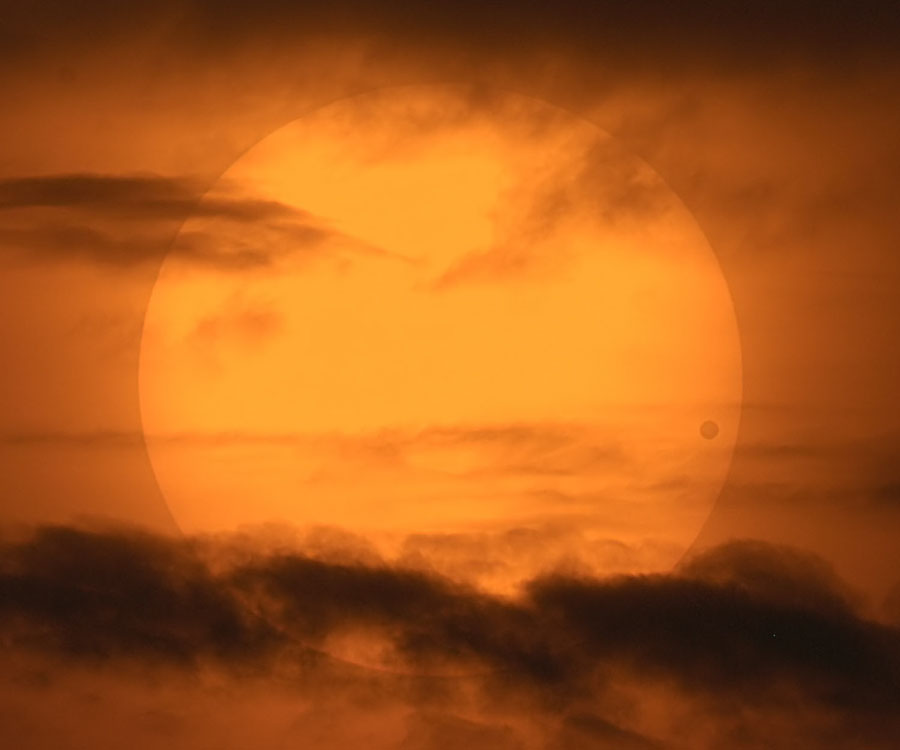
The rare transit of Venus across the face of the Sun in 2004 was one of the better-photographed events in sky history. Both scientific and artistic images flooded in from the areas that could see the transit: Europe and much of Asia, Africa, and North America. Scientifically, solar photographers confirmed that the black drop effect is really better related to the viewing clarity of the camera or telescope than the atmosphere of Venus. Artistically, images might be divided into several categories. One type captures the transit in front of a highly detailed Sun. Another category captures a double coincidence such as both Venus and an airplane simultaneously silhouetted, or Venus and the International Space Station in low Earth orbit. A third image type involves a fortuitous arrangement of interesting looking clouds, as shown by example in the above image taken from North Carolina, USA. The next transit of Venus across the Sun will be in 2012 June.

Subscribe to:
Posts (Atom)